

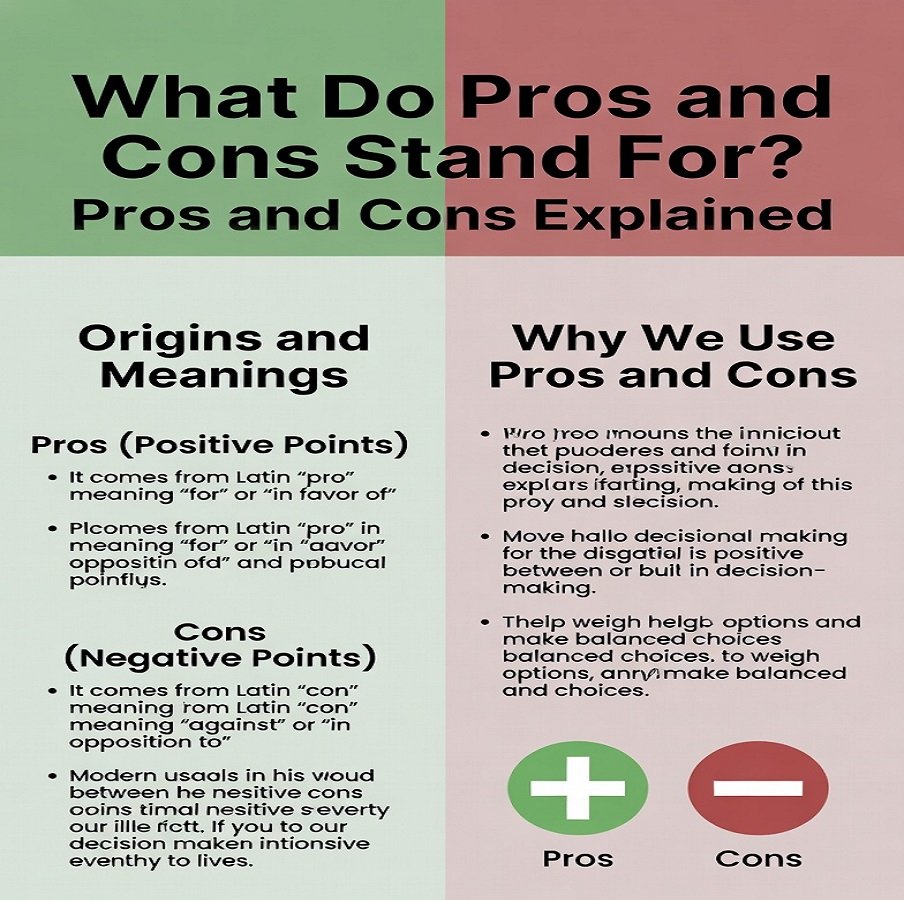
The phrase “pros and cons” is widely used across education, business, and daily life decisions. Many people ask themselves: what do pros and cons stand for? At its core, this framework represents a systematic way to weigh the advantages and disadvantages of any choice. Pros highlight the positive aspects, while cons identify the potential drawbacks.
What Do Pros and Cons Stand For? Meaning Pros and Cons
Together, they help people make informed decisions rather than relying solely on instinct or emotion. Using pros and cons effectively allows individuals to identify trade-offs, prioritize factors, and see both sides of a situation clearly. Whether you’re choosing a new job, purchasing a product, or planning a major life event, understanding what pros and cons stand for is essential for clear decision-making.
The Historical Origin of Pros and Cons
The terms “pros” and “cons” have their roots in Latin. “Pro” translates to “for” or “in favor of,” while “contra” means “against.” These terms were historically used in formal debates, academic arguments, and legal reasoning. Presenting arguments pro and contra ensured that every side of a discussion was carefully examined, promoting fairness and balance. Over centuries, the Latin terms evolved into modern English usage. Today, pros and cons appear in a wide range of contexts, from classroom exercises to corporate strategy meetings, providing a timeless framework for analyzing choices.
The Modern Meaning of Pros and Cons
In contemporary usage, pros and cons serve as a tool to assess decisions logically: Pros: Positive factors that support a decision, such as benefits, advantages, or favorable outcomes. Cons: Negative factors that oppose a decision, such as risks, drawbacks, or potential consequences. For example, when deciding whether to accept a remote job offer, a pros and cons list might look like this:
Example Table: Remote Work Decision
| Pros | Cons |
|---|---|
| Flexible schedule | Isolation from colleagues |
| Reduced commuting time | Potential distractions at home |
| More family time | Fewer networking opportunities |
| Cost savings on transportation | Risk of decreased career visibility |
Seeing both sides clearly helps individuals make decisions aligned with personal or professional priorities.
Why Pros and Cons Are Valuable in Decision-Making
Pros and cons are powerful because they provide structure in situations where choices are complex. They encourage balanced thinking by requiring an examination of both positives and negatives. This approach minimizes impulsive decisions and allows for rational analysis. Additionally, pros and cons are highly accessible. No specialized tools or training are needed—simple pen and paper or digital notes suffice. For complex decisions, assigning weights or scores to each factor can add precision and help prioritize what matters most.
Using Pros and Cons in Everyday Life
Even small daily choices can benefit from pros and cons analysis. Examples include:
Buying a New Phone
| Pros | Cons |
|---|---|
| Latest features | Higher cost |
| Better camera | Battery may drain faster |
| Improved performance | Learning curve for new interface |
| Resale value | Potential compatibility issues |
Choosing a College
| Pros | Cons |
|---|---|
| Strong academic programs | High tuition |
| Scholarship opportunities | Distance from home |
| Campus culture | Living costs |
| Networking opportunities | Possible limited course options |
This method helps visualize both benefits and drawbacks before making a commitment.
Pros and Cons in Education
Teachers often use pros and cons exercises to enhance critical thinking skills. By analyzing both sides of an issue, students learn to: Evaluate evidence thoroughly Avoid biased reasoning Communicate arguments clearly Anticipate counterpoints For instance, in a debate on renewable energy, students might list reduced emissions and long-term sustainability as pros, and high initial costs or technological limitations as cons. This structured approach fosters analytical thinking and persuasive communication.
Pros and Cons in Business and Professional Contexts
Businesses rely on pros and cons to make strategic decisions. For example, before launching a new product, companies may evaluate:
Example Table: Product Launch Decision
| Pros | Cons |
|---|---|
| Potential market growth | High development costs |
| Competitive advantage | Market saturation risks |
| Brand diversification | Uncertain customer adoption |
| Innovation leadership | Possible operational strain |
Assigning numerical scores to each pro and con can improve clarity and aid in prioritizing decisions, ensuring resources are allocated effectively.
Common Mistakes When Using Pros and Cons
While pros and cons are useful, they can be misapplied. Common mistakes include:
Treating All Points as Equal
Not all pros and cons carry the same weight. A minor drawback may be listed alongside a major risk, creating a misleading impression.
Letting Bias Influence the List
People often emphasize positives they favor while downplaying significant negatives. Objective analysis requires honesty and careful evaluation.
Oversimplifying Complex Decisions
Some decisions involve uncertain or long-term consequences that cannot be captured in simple lists. Additional analysis or decision-making tools may be necessary.
Focusing Only on Quantity
Having more pros than cons does not automatically make a choice better. The quality and significance of each factor matter more than the number of items listed.
Best Practices for Effective Pros and Cons Analysis
To use pros and cons effectively: Clearly define the decision. List pros thoroughly. List cons thoroughly. Assign weights or scores to reflect importance. Review the list in context of short-term and long-term impact. Seek outside input to identify overlooked factors. Combine the list with factual data and research when available.
Pros and Cons in the Digital Age
Online, pros and cons have become the dominant framework for research and decision-making. Product comparison websites, review platforms, and informational blogs use structured pros and cons to guide users quickly. Search engines also highlight results such as “pros and cons of remote work” or “pros and cons of AI tools,” showing the method’s importance in modern content consumption.
Final Thoughts
Understanding what do pros and cons stand for is key to making smarter, more balanced decisions. Rooted in the Latin terms pro and contra, pros and cons remain a timeless framework to evaluate advantages and disadvantages across personal, educational, and professional contexts. When applied carefully, this approach encourages clarity, reduces bias, and helps align decisions with goals.
Give this article a score — how helpful was this pros and cons guide? Share your rating and your thoughts in the comments below.


Comments (2)
Pros and Cons of Technology Transforming Modern Business – JMConssays:
February 11, 2026 at 4:24 am[…] points. Choose tools that directly address challenges rather than following trends. Resources like Pros and Cons Explained offer guidance on structured evaluation for technology […]
Pros and Cons of Lifestyle Choices: Complete Guide – JMConssays:
February 11, 2026 at 5:03 am[…] Internal link: Learn how lifestyle choices affect decision-making in our guide What Do Pros and Cons Stand For. […]